Segmentation lets you divide your audience into smaller, targeted groups based on who your contacts are and how they have engaged with your emails. A segment is dynamic: Mailercloud re-checks the conditions for you, so contacts join and leave the segment automatically as their data and behaviour change.
This article lists every condition you can set in the segment builder, along with the operators and values each one accepts.
Log in to your Mailercloud account.
Select Audience from the left sidebar, then click Segments.
Click Create Segment on the top right.
Enter a Segment name. You can use up to 60 characters.
Choose your Audience source. Select All contacts to include every contact in your account, or Specific lists to limit the segment to the lists you choose.
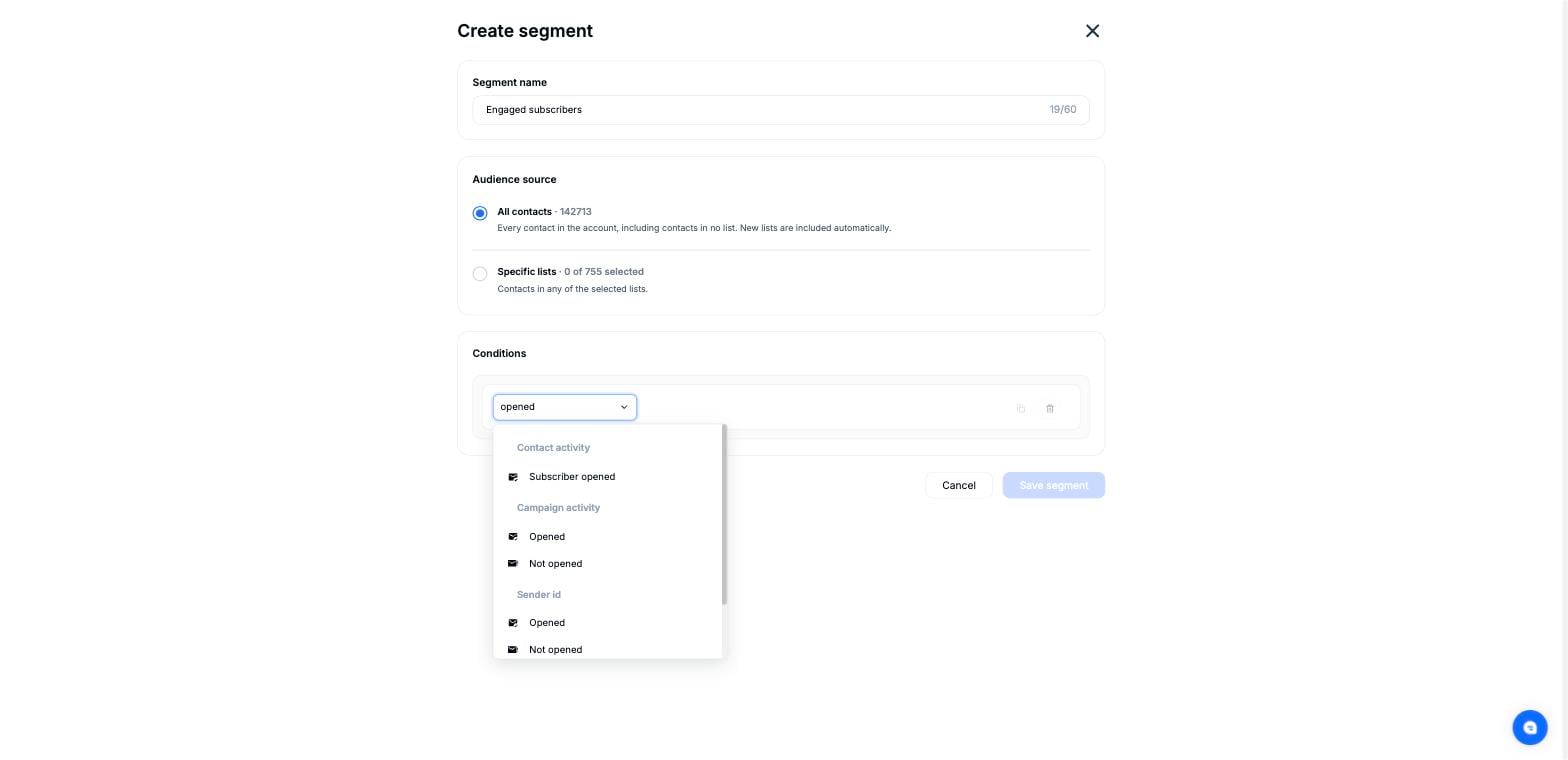
Click Add Conditions, then click Choose filter and select a condition.
Choose an operator and enter a value for the condition.
Click Save segment.
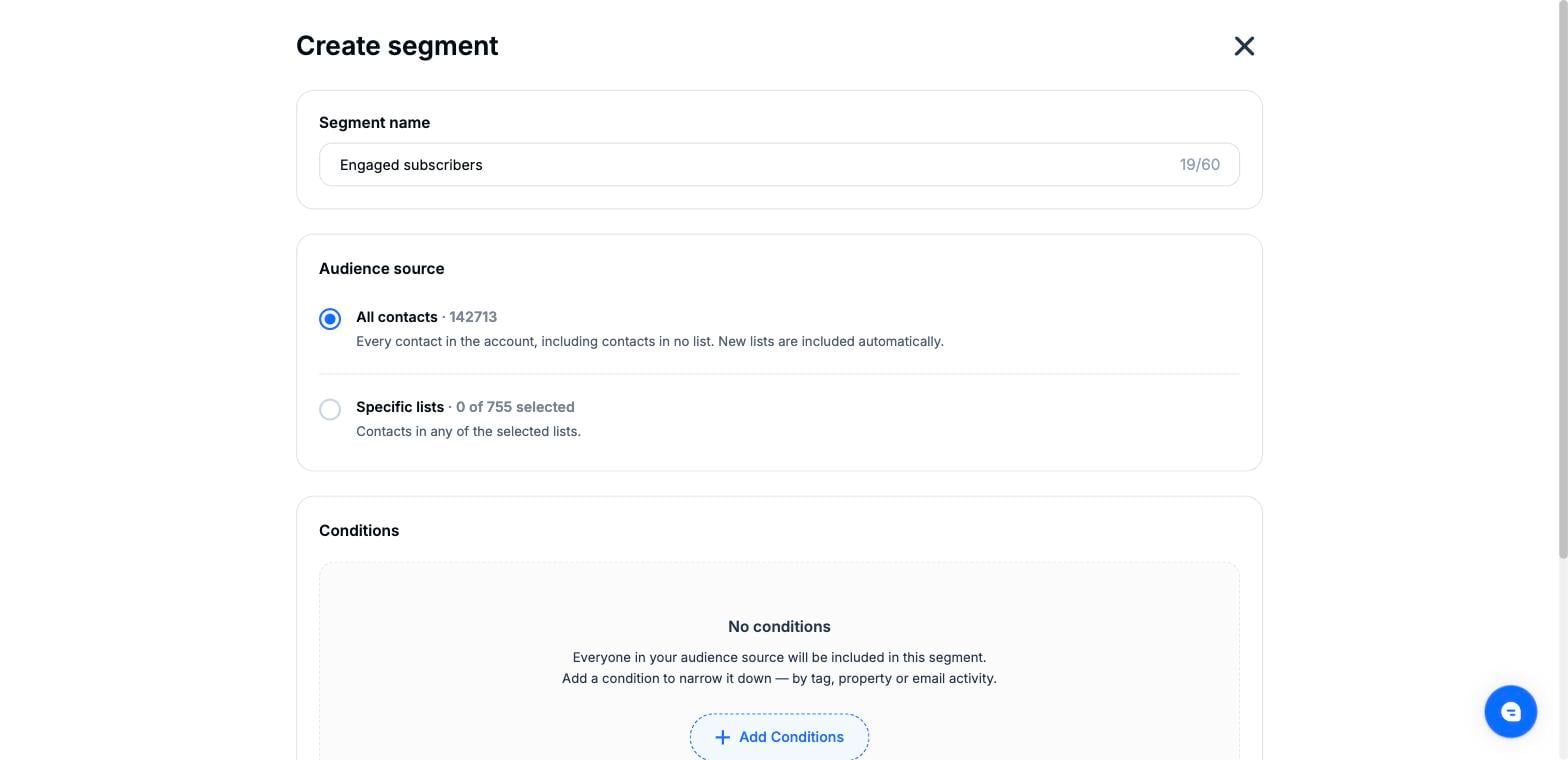
🔹 If you do not add any conditions, the segment will include everyone in your audience source.
🔹 Start typing in the Choose filter box to search for a condition by name. This is the quickest way to find a condition without scrolling the whole list.
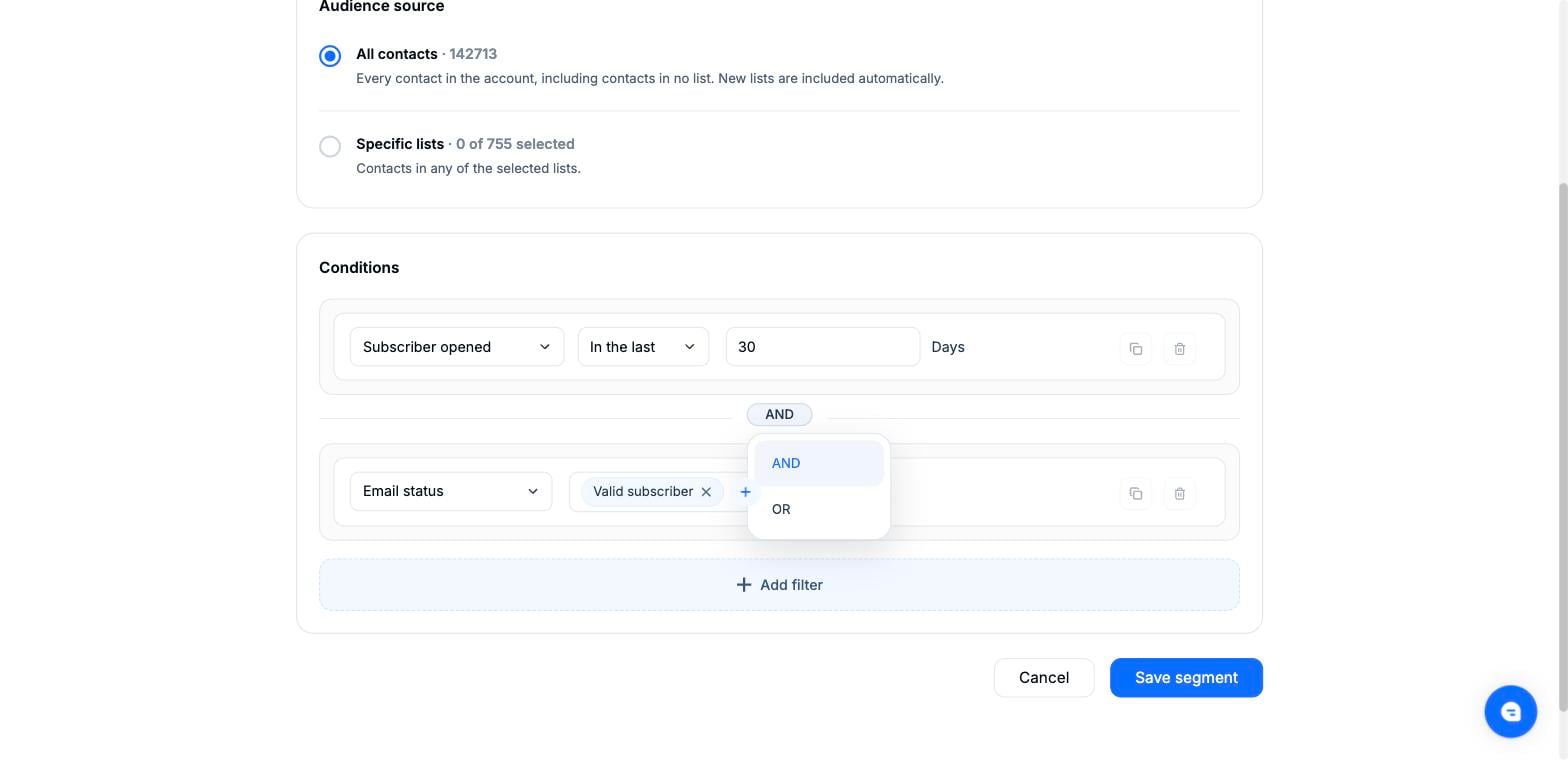
When you add a second condition, an AND label appears between the two conditions. Click it to switch between:
AND – a contact must satisfy every condition. Each condition you add makes the segment smaller.
OR – a contact needs to satisfy only one condition. Each condition you add makes the segment larger.
📌 This is the most common reason a segment returns no contacts. For example, Country is India AND Country is Germany matches nobody, because a contact cannot have two countries. Use OR for conditions like this.
The conditions are grouped by what they describe.
These are the details stored on the contact record, including the default fields and any custom contact properties you have created. Your custom fields appear with the names you gave them.
Default properties available:
Email Address, First Name, Middle Name, Last Name, Phone
Mailbox Provider, Country, State, City, Postal Code
Company Name, Job Title, Department, Industry, Salary
Lead Source
Open Tracking Consent, Open Tracking Consent Source, Open Tracking Consent Date
Email Preference, Email Frequency
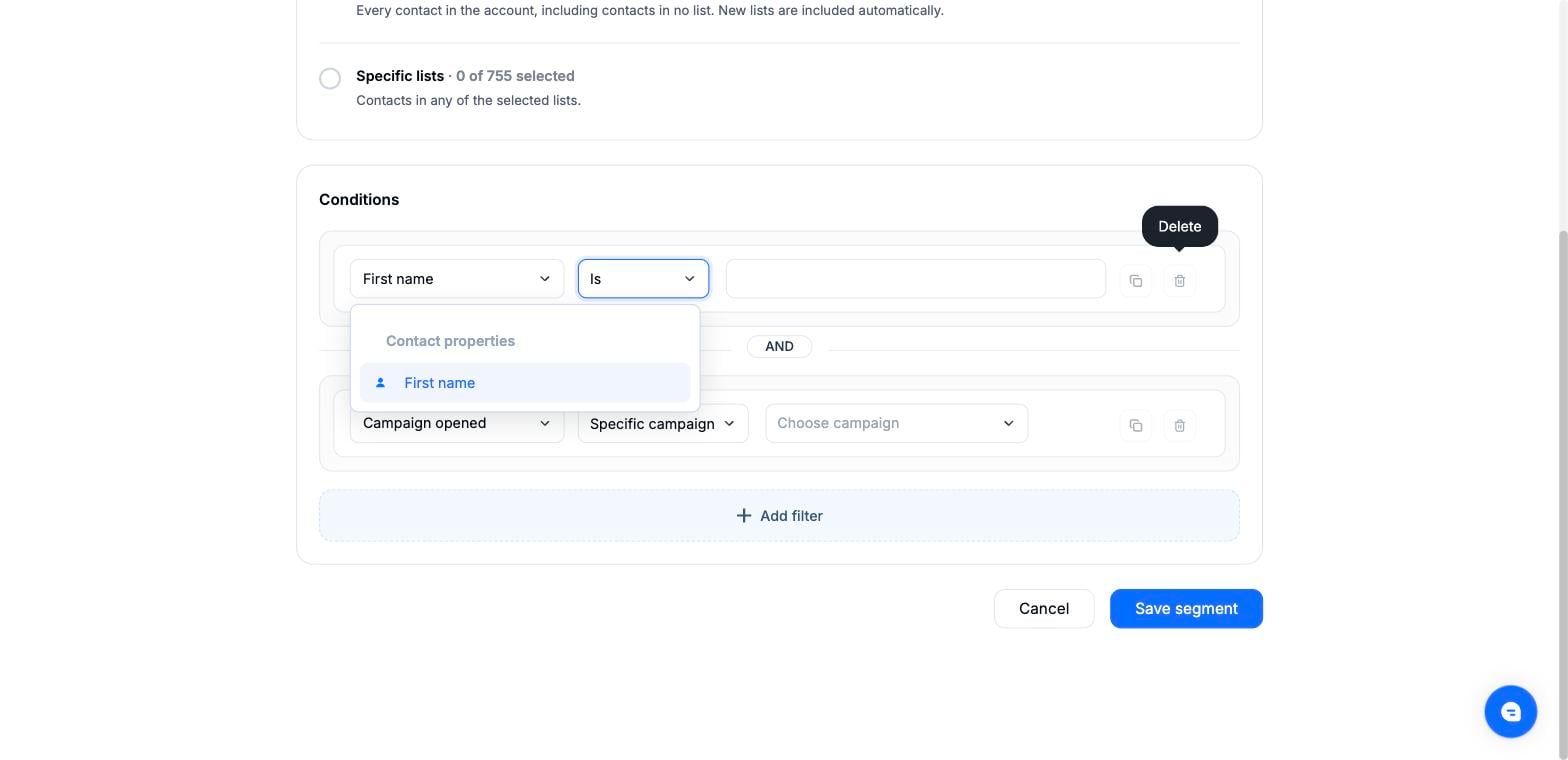
The operators available depend on the type of the property:
Text properties (First Name, Company Name):
Is / Is not
Contains / Does not contain
Starts with / Ends with
Is known / Is unknown
Number properties (Salary, Postal Code):
Equal to
Greater than / Less than
Between
Is known / Is unknown
Date properties:
On a specific date
Is before / Is after
Between
In the last / Not in the last
Is not
Is known / Is unknown
Dropdown and Radio properties:
Is / Is not
Is any of / Is none of
Is known / Is unknown
Multi-select and Checkbox properties:
Is any of / Is none of
Is known / Is unknown
Boolean properties:
Is / Is not
Is known / Is unknown
🔹 Email Address also offers Doesn't end with, which is the quickest way to exclude an entire domain.
🔹 Mailbox Provider uses Was / Was not and Is known / Is unknown.
🔹 Is known / Is unknown check whether the property has any value at all. For example, First Name is unknown finds every contact you cannot personalise an email to.
Open Tracking Consent – Is / Is not / Is known / Is unknown. Values: Granted, Denied.
Open Tracking Consent Source – Is / Is not / Is known / Is unknown. Values: Form, Preference center, Revocation link, Import, API, Manual.
Open Tracking Consent Date – uses the date operators listed above.
Email Preference – Was / Was not. Values: your own preference categories.
Email Frequency – Is / Is not / Is known / Is unknown. Values: Daily, Weekly digest, Monthly.
📌 Contacts whose tracking consent is Denied or unknown still receive your emails. Only the individual attribution of their opens is affected.
Email Status – Valid subscriber, Unknown subscriber, Bounced, Suppressed, Unsubscribed, Blacklisted, Account level bounced. You can select more than one value.
Email Domain – Is / Is not, Contains / Does not contain, Starts with / Ends with.
Created Date – On a specific date, Is before / Is after, Between, In the last / Not in the last, Is not.
Modified Date – same operators as Created Date.
Signup Source – Was / Was not. Choose from the sources listed in the dropdown.
Contact Rating – Equal to, Not equal to, Greater than, Less than, Between.
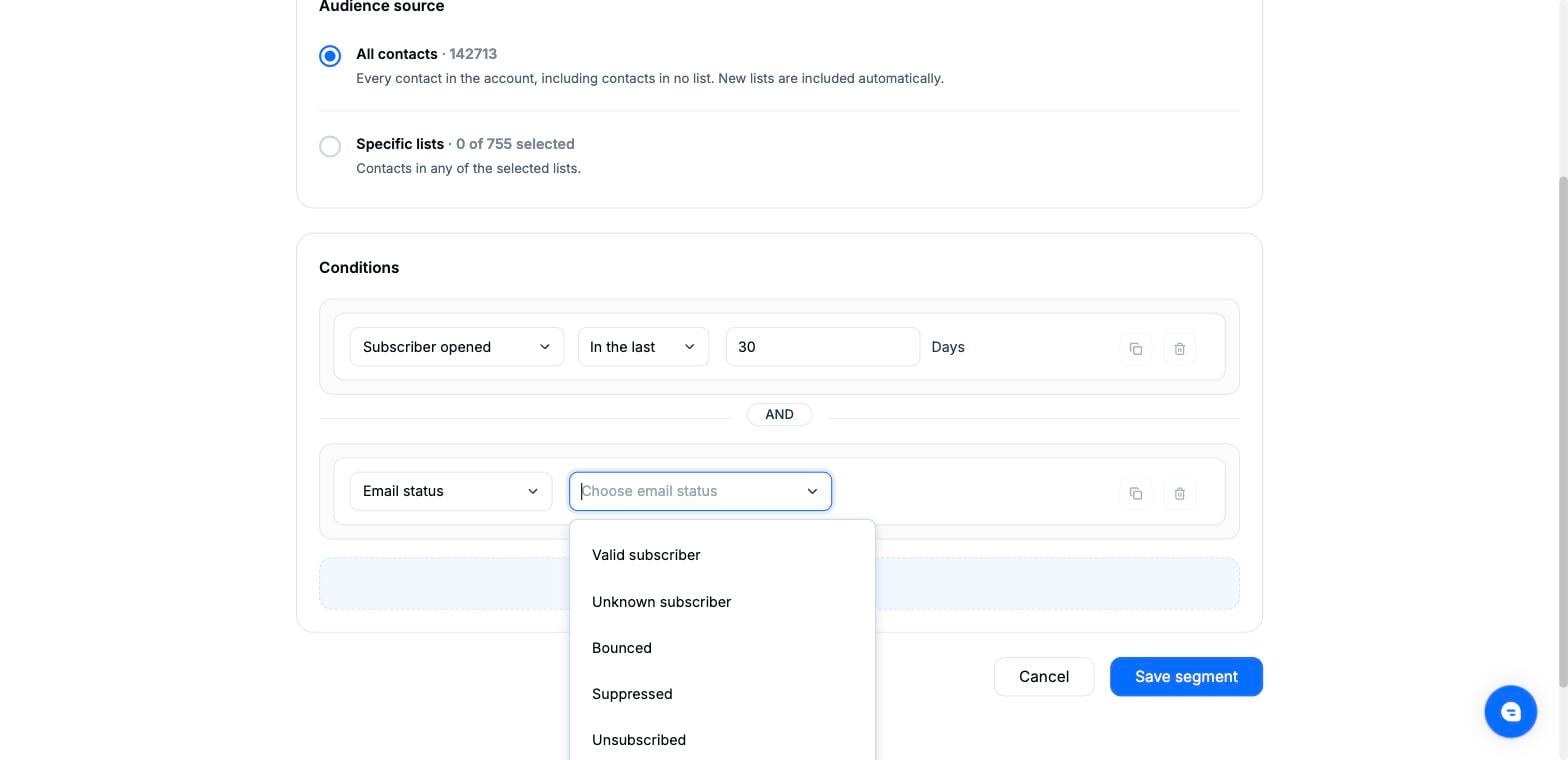
🔹 Suppressed, Bounced, Unsubscribed and Blacklisted contacts are already excluded from your sends automatically. You do not need a condition to keep them out. Use these values when you want to review those contacts, for example to size a re-permission campaign.
These conditions use the results of Mailercloud's email verification. They apply only to addresses that have already been verified.
Verification Result – Is / Is not / Is known / Is unknown. Values: Valid, Invalid, Risky, Unknown.
Verification Detail – Is / Is not / Is known / Is unknown. Values: Deliverable, Mailbox not found, Dead server, Invalid MX, Invalid syntax, Typo, Email disabled, Catch-all, Mailbox full, Disposable, Spamtrap, Role-based, Antispam system.
Deliverability Score – Equal to, Greater than, Less than, Between, Is known / Is unknown.
Risk Level – Is / Is not / Is known / Is unknown. Values: Low, Medium, High.
Email Type – Is / Is not / Is known / Is unknown. Values: Personal, Business, Role, Disposable, Unknown.
Verification Source – Is / Is not / Is known / Is unknown. Values: List upload, Single verify, Signup form, Automation, Import API.
Verification Status – Is / Is not / Is known / Is unknown. Values: Never, Verifying, Verified, Stale, Failed.
Email is Valid, Email is Deliverable, Role-based Email, Free Email Provider, Catch-all Domain, Disposable Email – Equal to (Yes / No), Is known / Is unknown.
MX Server – Is / Is not, Contains / Does not contain, Is known / Is unknown.
Last Verified – uses the date operators.
Subscriber Opened – In the last, Not in the last, Count, Count between, Order by count, Between date, After, Before, Between time.
Subscriber Clicked – In the last, Not in the last, Count, Count between, Order by count, Between date, After, Before.
Subscriber Sent – In the last, Not in the last, Count, Count between, Order by count, Between date, After, Before.
Engagement Status – Opened, Clicked, Not opened, Not clicked.
Subscriber In Portion – Between.
Global Engagers – Equal to, Not equal to, Greater than, Less than, Between, Order by, In the last, Not in the last.
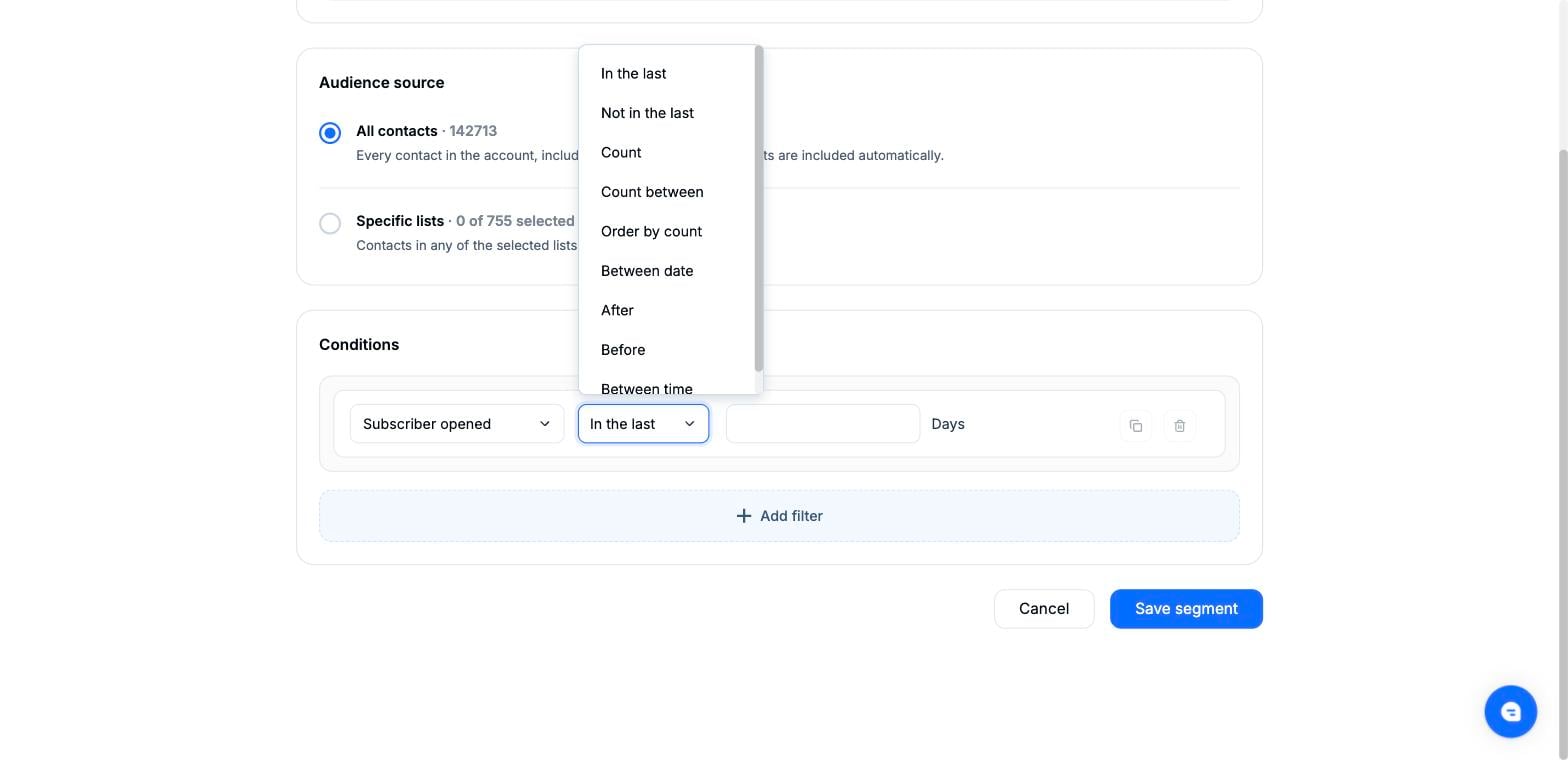
🔹 In the last / Not in the last take a number of days and move forward with time. "Opened in the last 30 days" always means the most recent 30 days.
🔹 Count and Count between filter on how many times the activity happened, which helps you separate regular clickers from one-time clickers.
🔹 Between time is available for opens only and filters by time of day.
🔹 Subscriber In Portion takes a percentage range and returns an even slice of your audience. Use it to build a holdout group or split a list for testing.
🔹 Global Engagers is available on request. Contact support if you do not see it.
Conditions: Opened, Clicked, Sent, Not opened, Not clicked, Not sent.
Operators:
Specific campaign – choose the campaign or campaigns by name
Any of the last 5 campaigns
All of the last 5 campaigns
Any of the campaign sent in the last 7 days
Any of the campaign sent in the last 1 month
Any of the campaign sent in the last 3 months
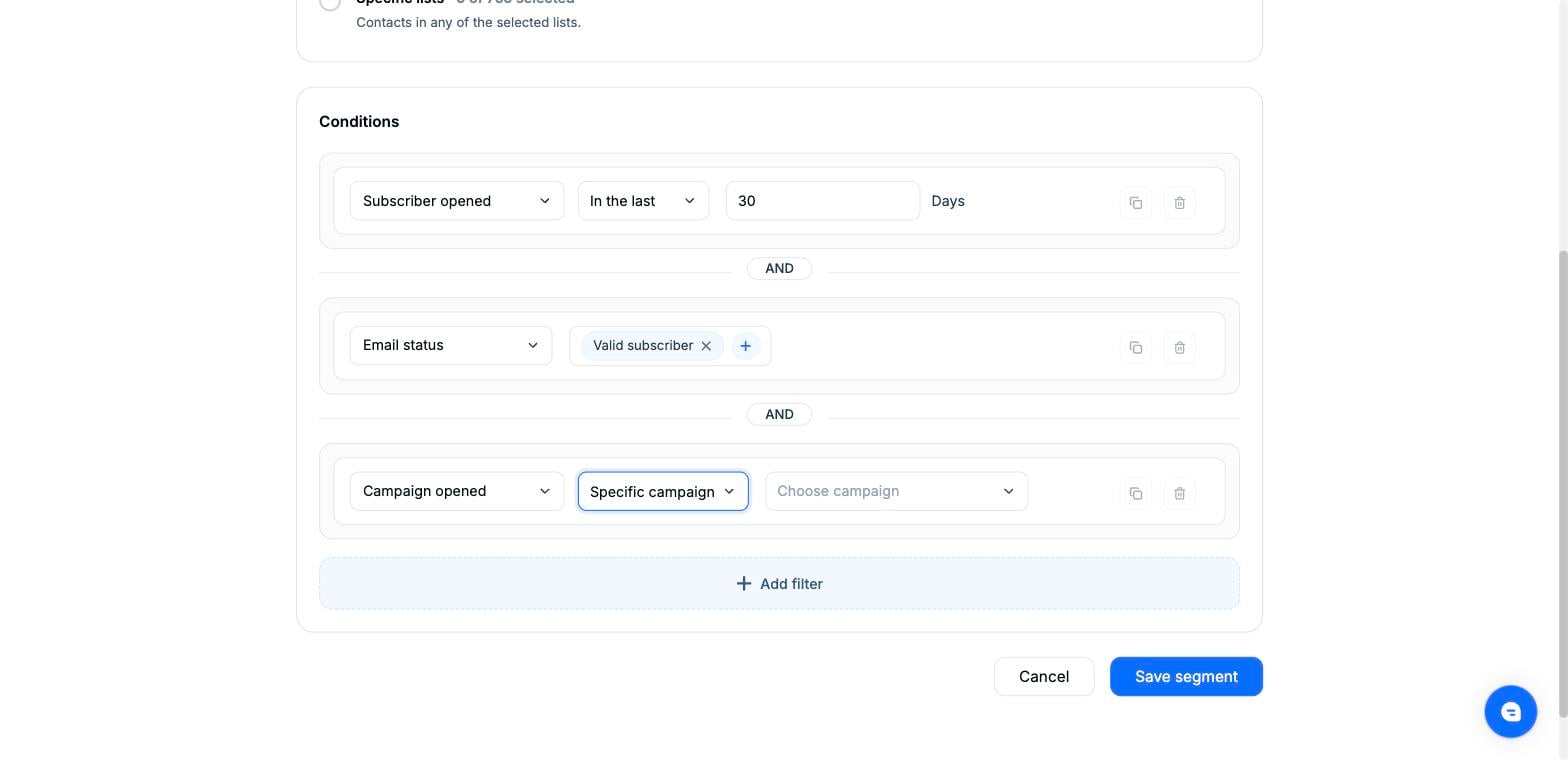
🔹 Not sent offers Specific campaign, Any of the last 5 campaigns and All of the last 5 campaigns only.
🔹 The rolling operators keep working as you send new campaigns, so you do not have to edit the segment each time. Not opened – All of the last 5 campaigns is a common way to define lapsed subscribers.
Conditions: Opened, Clicked, Sent, Not opened, Not clicked, Not sent, using the Specific operator. These are scoped to the sender address the campaign was sent from, which is useful when your account sends under more than one brand.
Started automation / Not started automation
Completed automation / Not completed automation
Currently in automation / Not currently in automation
Dropped off automation
Entered via trigger
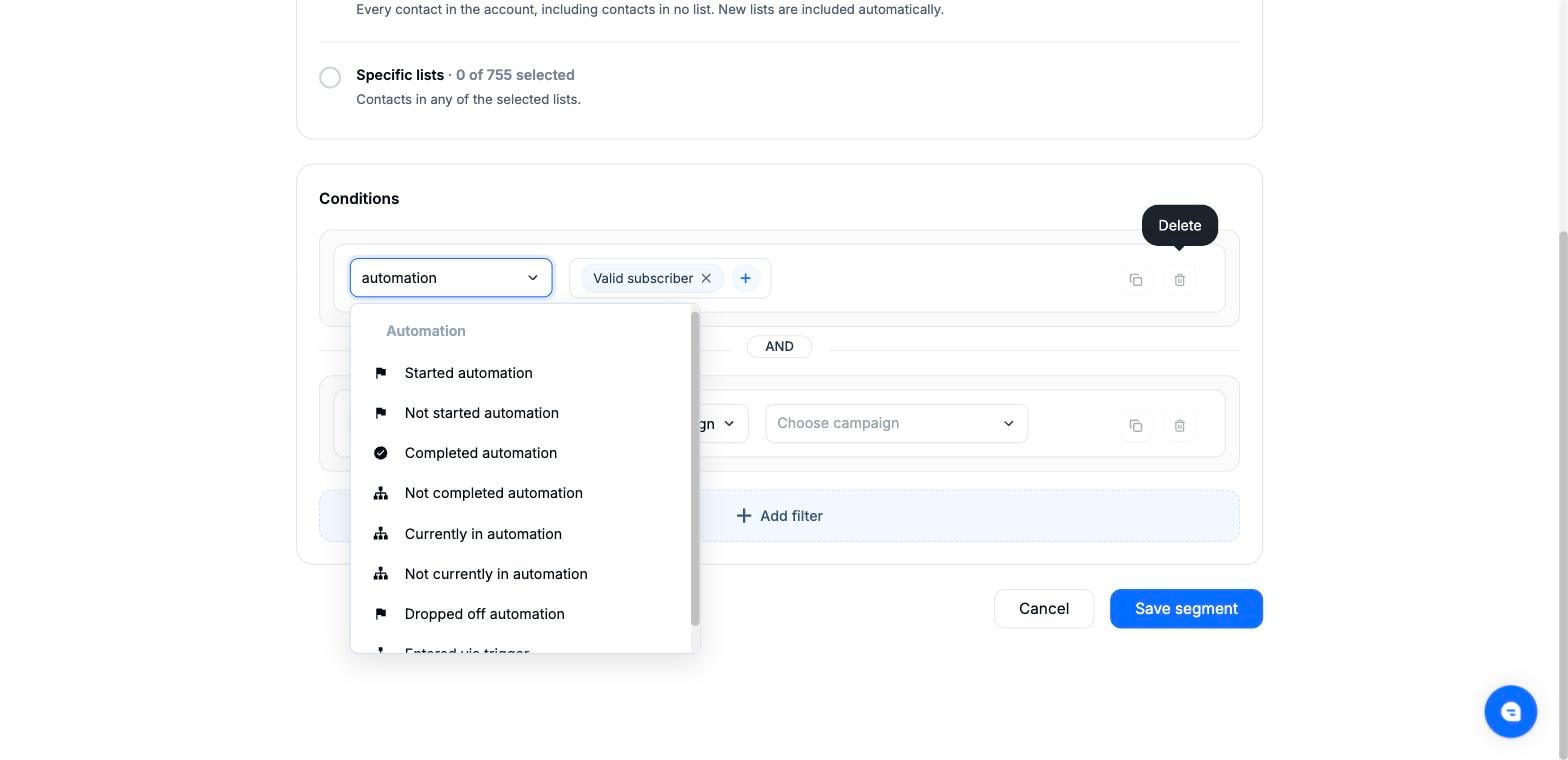
Each uses the Specific operator, where you choose the automation. Entered via trigger also asks you to choose which trigger added the contact to the automation.
🔹 Automation conditions are available on plans that include automation.
Has happened – Specific, In the last, On, After, Between.
Not happened – Specific.
Is tagged – Any of, All of.
Is not tagged – Any of, All of.
🔹 Any of matches a contact with at least one of the selected tags. All of requires every selected tag.
Opened – Is.
Clicked – Is.
🔹 Campaign tags let you segment by theme instead of by individual campaign. A condition such as "Clicked campaigns tagged pricing" keeps working as you add new campaigns under that tag.
Engaged subscribers – Subscriber Opened in the last 30 days AND Email Status is Valid subscriber.
Lapsed subscribers – Subscriber Opened not in the last 90 days AND Email Status is Valid subscriber.
New contacts – Created Date in the last 7 days.
Interested but not converted – Campaign tag Clicked is pricing AND Conversion Not happened.
Business addresses only – Free Email Provider equal to No.
Two regions – Country is India OR Country is Singapore.
10% holdout group – Subscriber In Portion between 0 and 10.
Number of conditions – A segment can hold a limited number of conditions, commonly 5, depending on your plan. Once you reach the limit, no further conditions can be added.
Activity conditions and OR – Contact activity conditions such as Subscriber Opened, Clicked and Sent cannot be combined using OR. Use AND when your segment includes one of them.
Segment counts – The contact count shown is from the last refresh, not a live count. Refresh the segment from the segment list to update it.
Empty segments – If a segment returns no contacts, check whether you have used AND where OR was intended.
Audience source – If your segment is scoped to specific lists, activity from contacts outside those lists is not considered.
Verification conditions – These return no contacts if the addresses in your account have not been verified yet.
If you have any further questions or need assistance, Mailercloud's support team is ready to help you.